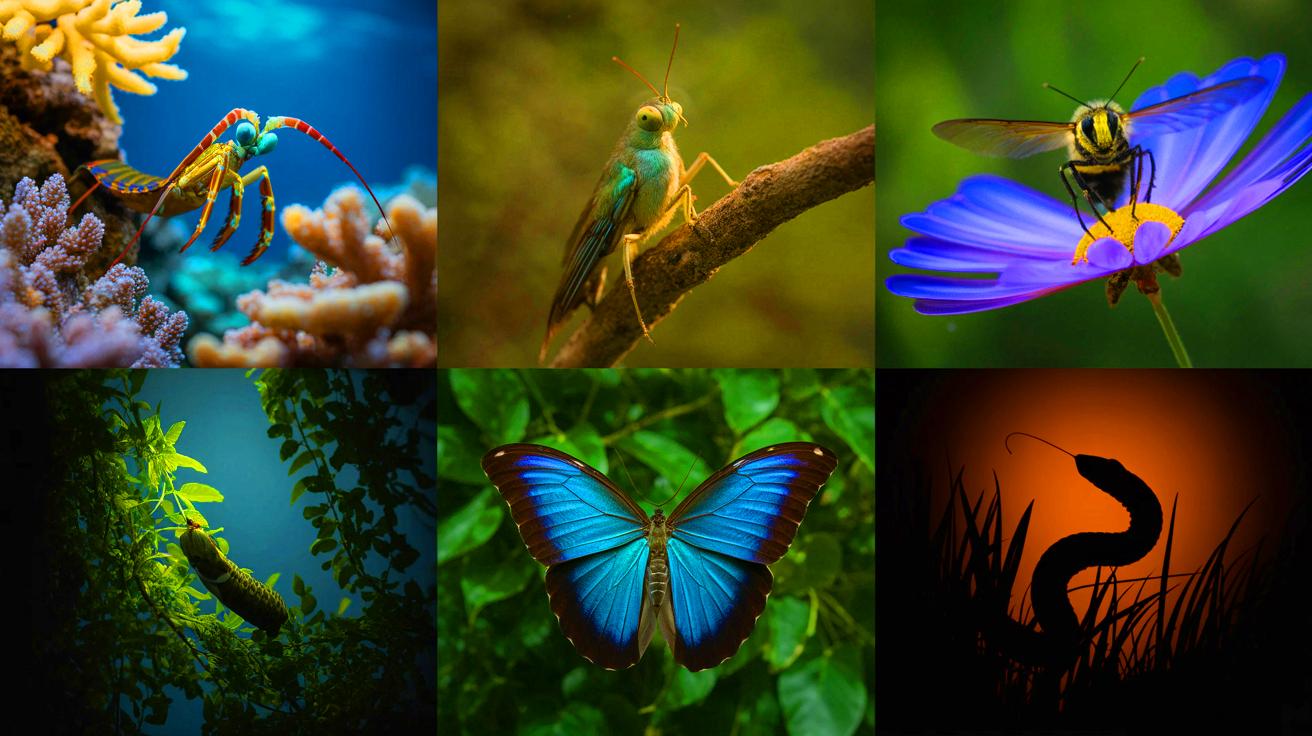
What You Need to Know
- 🌈 The mantis shrimp possesses up to 16 types of color receptors, enabling it to see UV, infrared, and polarized light, revealing a vibrant world beyond human perception.
- 🦜 Many birds, like the European starling, perceive ultraviolet light, which helps them with mate selection, food identification, and predator awareness, revealing an intricate visual world.
- 🐝 Bees utilize ultraviolet nectar guides on flowers to efficiently collect nectar, underscoring their crucial role in pollination and the interconnectedness of nature.
- 🦋 Butterflies, such as the swallowtail, have up to 15 color receptors, allowing them to discern a wide range of colors, vital for foraging and mating choices.
- 🐍 Some reptiles, like pit vipers, use infrared perception via pit organs to detect heat signatures, gaining an advantage in hunting that highlights the versatility of nature’s adaptations.
Imagine a world bathed in colors beyond the reach of human sight. Some animals navigate through this vibrant panorama daily, perceiving hues and shades that elude our senses. This realm, unseen by human eyes, offers insights into the diverse ways life thrives on our beautiful planet. Delving into the unique visual experiences of these creatures is not just a foray into science but an exploration of the wonders that make our world extraordinary. Prepare yourself to discover how some animals view the world in ways we can only dream of.
The Mantis Shrimp: Nature’s Rainbow Visionary
The mantis shrimp holds the prestigious title of possessing one of the most complex visual systems on Earth. With up to 16 types of color receptors, compared to the paltry three of humans, it detects a spectrum of colors we can’t even fathom. This tiny marine crustacean doesn’t just interpret these colors; it utilizes them for survival, communication, and navigation in its vibrant coral reef habitat.
The mantis shrimp’s ability to see UV, infrared, and polarized light enables it to identify prey and potential mates effectively. Its extraordinary vision challenges our understanding of color perception and offers a glimpse into a radiant world that human eyes can’t see. The mantis shrimp exemplifies how nature’s innovations surpass our limited grasp of reality.
Birds See Beyond the Rainbow
While humans delight in the beauty of a rainbow, birds witness an array of colors melded into hues invisible to us. Many bird species, like the European starling, see in the UV spectrum. This ability plays a crucial role in identifying mates, finding food, and even perceiving predators. Their feathers often boast UV markings that attract potential partners but remain unseen by predators.
For birds, ultraviolet perception is a survival trait. It helps them distinguish fruitful berries from intoxicating ones and decipher signals in plumage that indicate fitness and compatibility. Birds see an enriched and intricate world, full of visual cues that guide their behaviors and interactions. These avian marvels show us a vivid tapestry of nature’s artwork that humans can only admire from afar.
Bees and Their Secret UV Guide
Bees, the industrious pollinators of our world, view flowers through an ultraviolet lens, transforming a simple garden into a stunning landscape of patterns and signals. These UV patterns act as nectar guides, directing bees to their reward, thus enhancing pollination.
This visual capacity ensures bees efficiently find and collect nectar, facilitating the propagation of various flowering plants. A garden, to a bee, is a symphony of sensory information, each blossom whispering sweet promises through ultraviolet wavelengths. Their incredible ability to see what we cannot reinforces the interconnectedness of nature and the essential role of every species in our ecosystem.
Butterflies and Their Multichromatic World
Butterflies flit gracefully through gardens, drawn by a myriad of colors. Some species, like the swallowtail, possess up to 15 color receptors—comparatively much more than humans. This poly-chromatic vision enables them to discern a vast range of colors, influencing their foraging habits and mating choices.
Their kaleidoscopic view of the world helps them identify the most rewarding flowers, ensuring they efficiently gather nourishment. Butterflies depend on this enhanced color discrimination not only to survive but also to perpetuate their species, ensuring the proliferation of countless plants through effective pollination. Through their eyes, the world is an intricate masterpiece painted in shades unknown to us.
- Mantis shrimp detect UV and polarized light.
- Birds see differentiated UV markings on feathers.
- Bees navigate gardens using UV nectar guides.
- Butterflies utilize an extensive range of colors for foraging.
Reptiles: Masters of Infrared Perception
Beyond visible colors, some reptiles, like pit vipers, wield an extraordinary adaptation: infrared vision. Though not color in the traditional sense, this ability allows them to detect heat signatures, painting a living map of warm-bodied prey in their environment. This capability is invaluable for hunting in the dark or amidst dense foliage.
Their pit organs, located between the eyes and nostrils, facilitate this infrared perception, granting them a sixth sense that transforms their understanding of the world around them. Through this unique adaptation, pit vipers inherit a versatile and effective hunting strategy. These silent and efficient predators remind us that nature’s versatility knows no bounds.
The animal kingdom is a canvas splashed with colors and senses that extend far beyond human cognition. From the iridescent world of the mantis shrimp to the ultraviolet landscapes of birds and bees and the infrared vistas for reptiles, these creatures provide remarkable insights into the infinite possibilities of sensory perception. Their existence raises poignant questions about our own limitations: What other wonders remain hidden from our eyes, gently urging us to explore and cherish the diverse life around us?
Wow, the mantis shrimp sounds like a real-life superhero! 🦐💥
Does seeing in UV help birds recognize each other better?
I never knew bees had such a cool way to find flowers! Nature’s truly amazing.
So butterflies see colors we can’t even imagine? That’s wild! 😲🦋
The ability of pit vipers to see infrared heat sounds like science fiction. 🔥🐍
How do scientists even figure out how these animals see? 🧐
Oh man, I want mantis shrimp powers! 16 color receptors? Crazy. 😜
Do these special sights help animals live longer lives?
Bees seeing UV patterns feels like having secret treasure maps everywhere! 🍯
Whoa, birds have superpowers too! What can I do with UV vision? 🤔🐦
I’m really curious how humans could potentially see UV or IR like animals do.
This makes me appreciate color more in my surroundings. 🌈
The mantis shrimp is known for its punch, but its vision is equally fascinating.
I can’t imagine seeing in UV. Everything must look so different!
Imagine if dogs could see as many colors as mantis shrimp, ball fetch would be wild! 🐕🦺
The science of animal vision is endlessly fascinating to me.
Wait, birds use UV to find food? That’s a super helpful skill!
I feel like I’ve just had my eyes opened—pun intended!
Does this mean some flowers look different to animals than to us?
Thinking about what I’m blind to every day is a humbling thought.
The complexity of nature is beyond what many people realize.
This post made me wonder how much more evolved we are yet to become.
Are there any animals that have more than 16 color receptors?
Loved this post! Learning about animal vision was eye-opening. 👁️
Oh, saw yur post and remembered a documentary about shrimp’s eyes!
I’m suddenly feeling very ordinary with my mere human eyesight. 😅
The idea of heat vision is super cool; pit vipers are so awesome.
Always amazed by butterflies’ special color vision; makes seeing them fly magical.
Cant help but wonder what else mantis shrimp can see in the ocean.
If only humans could see how bees navigate… must be like entering a kaleidoscope. 😊
I appreciate my eyesight more now, although limited.
Makes me think twice about being so entranced by sunsets.
Can our eyes ever be modified to see what other animals see? 🦄
Nature never ceases to amaze; this post is proof of it.
Always nice to learn something new! Animals are incredible.
Mantis shrimp rock the ocean! Defining new levels of vision mastery.
Why don’t we have animal vision exhibits in museums or zoos? 🤔
Loved learning about bird vision; they’re rockstars of the sky.
Butterflies seeing more colors confirms they’re fancy insects.
Glad I read this, I’ll never look at animals the same way.
Are there any animals that can see the full electromagnetic spectrum?
This post just added to the fascination I have with the natural world.
Bees must see gardens as wonderlands. Pretty sweet! 🐝🌷
So butterflies have a way cooler world view than we do? 😮
I wonder how artists feel about this concept of unseen colors. 🎨
Is it even possible to convey these unseen colors through technology?
Why wasn’t this taught in school? It’s fascinating.
This just made animal documentaries even more exciting for me.
I feel like there’s so much of the world we take for granted.
Does this mean some animals see us humans differently too?
Amazing to learn how different animal strategies are for survival.
Makes you realize how limited we are in our perception of reality.
Just mindblown by these animal capabilities. Incredible! 🤯
Amazing insights, thanks for sharing this fascinating perspective!
How do infrared and UV rays affect reptile hunting strategies?
I always knew animals were cool, but this is next level! 🦠
Nature’s fascinating design never ceases to impress.
Birds’ eye view takes on a whole new meaning now! 🦜
It’s like a superhero universe with all these visual powers. 🤩
So much more fascinating than I ever imagined! Thank you!
Can’t humans get some of these visual enhancements, please? 👓
Makes me sees the world in a whole new light, no pun intended! 🌟
Wish I could borrow a mantis shrimp’s eyes for a day!
Animals truly live in a hidden world full of wonders.
I’m constantly fascinated by animal adaptations! Truly amazing.
How do researchers find out these visual secrets of animals?
This made my day! Animals are awesome. Thanks for this! 😸
Let’s appreciate all the beauty and complexity nature offers us.
Pit vipers must be intimidating hunters, having infrared vision!
Reptiles are resilient creatures, especially with this cool adaptation.
Imagine living in such vibrant kaleidoscopes of color and light.
The post leaves me pondering over the magnificence of unseen colors.
Absolutely loved this! Animals are both fascinating and inspirational. 😍
Such incredible adaptations in nature keep me amazed every day. 🙌
Would love to know what motivates these vision faculties in evolution.
Animals perceive layers of detail unseen to humans, just makes them special.
The diversity of animal vision must make the world an interesting place.
Thanks for sharing these colorful insights into the animal world!
Feels like I’m experiencing a fantastic nature documentary here! 📺
How do these visual details change animals’ behavior and interactions?
Now I envy the mantis shrimp’s vision; my beach walks seem dull!
I had no idea, animals are teaching us so much just by existing!
Does knowing these abilities exist change how we view the world?
Makes the natural world seem even more like a vibrant mystery.
Amazing to think how the ocean would look through a shrimp’s eyes.
Been wanting to dive into deeper knowledge about animal senses.
Bees must feel like they live in their own magical kingdom! 🐝👑
Butterflies have such a whimsical yet practical approach towards life!
This world is far more stunning than we visualize every day.
Truly inspiring to know more about wildlife, thank you!
Makes me curious about what more we have yet to discover.
Had no clue about UV vision helping birds! Mind is officially blown.
Every post I read makes me wish for these animal superpowers! 🎉
Nature always has its surprises! It’s amazing what animals can do.
The harmonious interplay between nature and these animals is inspiring.
Can tech ever replicate what these animals naturally do? Hmmm…
Evolution is an artist, truly. 🌎
Love that there are worlds within worlds, hidden from human eyes.
The mantis shrimp should be called the king of rainbow vision! 👑
Eyes are such an integral part of survival, but I had no idea! 😲
Learning how different creatures see motivates me to respect all life forms.
I’m shocked and amazed at these revelations! Thank you for sharing!
To think animal capabilities are out there untouched by human discovery.
Feels like I’m stepping into a hidden, multifaceted universe now.
The more I learn, the more humbled I feel by nature’s creations.
Pit vipers are underrated players in the game of nature’s wonders!
Life around us is like an immense colorful quilt of existence.
Animal vision makes me wish I could borrow their senses for a day!